FANTASTIC VIDEO
GREAT


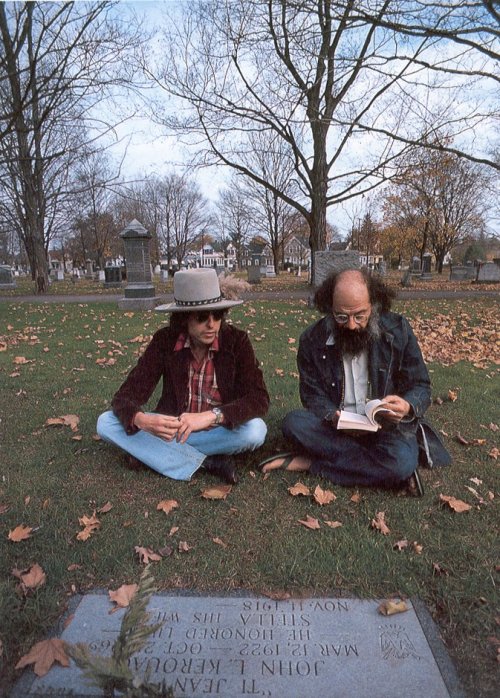
Dylan has recently been more forthcoming about his early influences. In both his autobiography, Chronicles, and the documentary film No Direction Home, he talks about the effect that reading Kerouac had on him.
He says that On the Road “had been like a bible for me. I loved the breathless, dynamic bop poetry phrases that flowed from Jack’s pen . . . I fell into that atmosphere of everything Kerouac was saying about the world being completely mad, and the only people for him that were interesting were the mad people, the mad ones, the ones who were mad to live, mad to talk, mad to be saved, desirous of everything at the same time, the ones who never yawn, all of those mad ones, and I felt like I fit right into that bunch.”
But Dylan adds: “One guy gave me a book that Woody Guthrie wrote called Bound For Glory, and I read it. I identified with that book more than I even did with On the Road.”
When Allen Ginsberg was travelling with Dylan during the Rolling Thunder Review tour of 1975 they visited Lowell, Massachusetts and stopped by Kerouac’s gravestone at Edson Cemetery, where, in a scene which appeared in the movie Renaldo and Clara, they read choruses from Kerouac’s Mexico City Blues. Ginsberg asked Dylan how he knew Kerouac’s poetry and Dylan replied: “Someone handed me Mexico City Blues in St. Paul [Minnesota] in 1959 and it blew my mind. It was the first poetry that spoke my own language.” Dylan mentions Mexico City Blues in his song Something’s Burning, Baby from the 1985 album Empire Burlesque.
Kerouac’s influence can also be heard on Dylan’s earlier album, Highway 61 Revisited. Two of the songs,Desolation Row and Just Like Tom Thumb’s Blues include direct quotes from Kerouac’s novel Desolation Angels, including the phrases "the perfect image of a priest," "her sin is her lifelessness," and "Housing Project Hill." It is also informative to compare the song title Desolation Row and the phrase "junkyard angel" (used in another of the songs on the album -- From A Buick 6) with the title of Kerouac's book.
Desolation Angels was published in May 1965, and Highway 61 Revisited recorded in August 1965. The book was the first major Kerouac work to appear after Dylan began writing songs in the early 1960s. Clearly, Dylan was sufficiently affected by Kerouac's book that he chose to write those phrases into his new songs.
Take route 495 into Lowell.
Exit onto Route 3A, a road which passes the cemetery.
After you park your car on the street, enter Edson Cemetery gates at 1375 Gorham Street.
Continue onto Lincoln Ave., walking towards the increasing street numbers until you reach 7th St.
Walk half a block more. Kerouac's grave is halfway between 7th and 8th St.

"I want to work in revelations, not just spin silly tales for money. I want to fish as deep down as possible into my own subconscious in the belief that once that far down, everyone will understand because they are the same that far down." -- Jack Kerouac
"If you're working with words, it's got to be poetry. I grew up with [the books of Jack] Kerouac. If he hadn't wrote On The Road, the Doors would have never existed. Morrison read On The Road down in Florida, and I read it in Chicago. That sense of freedom, spirituality, and intellectuality in On The Road — that's what I wanted in my own work." -- Ray Manzarek, keyboard player, The Doors
"I read On the Road in maybe 1959. It changed my life like it changed everyone else's." -- Bob Dylan
"Once when Kerouac was high on psychedelics with Timothy Leary, he looked out the window and said, 'Walking on water wasn't built in a day.' Our goal was to save the planet and alter human consciousness. That will take a long time, if it happens at all." -- Allen Ginsberg

